
Academics
At Reliance Foundation School, academics are aligned with NEP 2020 and the National Curriculum Framework, ensuring learning that is competency-based, experiential, and rooted in real-world application. The curriculum is designed to help students develop essential 21st-century skills-critical thinking, creativity, collaboration, communication, digital fluency, and social-emotional resilience-preparing them for a rapidly evolving world.
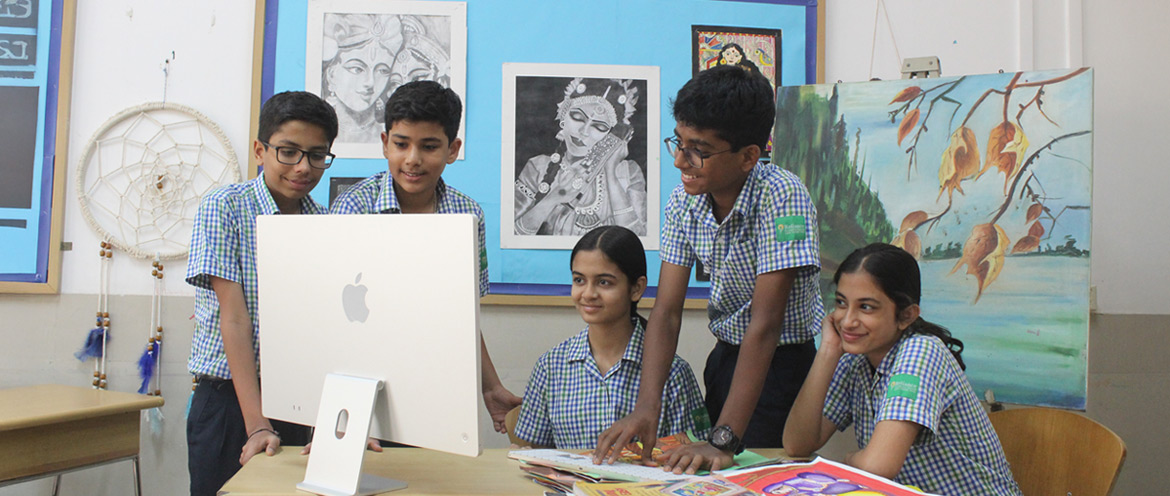
To strengthen digital literacy and AI awareness, students from Classes 6 to 12 participate in the AI Classroom Foundation Course, developed by Jio Institute. This programme introduces learners to the fundamentals of Artificial Intelligence and builds practical digital competencies through guided use of leading AI tools. By integrating such future-ready learning experiences, the school nurtures inquiry, curiosity, innovation, and responsible technology use, ensuring students grow as confident, adaptable, and forward-thinking learners.
The school's approach to holistic development focuses on nurturing emotional wellbeing, resilience, empathy, compassion, and emotional intelligence alongside academic growth. Students develop essential skills for lifelong learning - including learning-to-learn strategies, collaboration, communication, and responsible decision-making - ensuring they grow into confident, self-aware and adaptable individuals.
A 15:1 student-teacher ratio enables differentiated instruction and personalised learning. Students receive targeted support, learn at their own pace, and engage meaningfully with concepts through guidance that responds to their individual strengths, challenges, and learning styles.
The school adopts a comprehensive competency-based education framework that focuses on mastery, application, and deep understanding of concepts. Curriculum design is intentionally structured through vertical integration, ensuring continuity and progression of learning across classes, and horizontal integration, which aligns concepts within a class level. Students engage with both multidisciplinary and interdisciplinary learning experiences, allowing them to connect ideas across domains and apply knowledge in meaningful contexts.
The approach emphasises research, scientific inquiry, analytical thinking, and problem-solving, encouraging students to question, investigate, evaluate evidence, and make informed decisions. Learning is strengthened through experiential tasks, exhibitions, projects, research assignments, and internships, enabling students to demonstrate competencies through authentic application rather than rote recall. This framework nurtures curiosity, essential values, and attitudes, preparing students to think independently, respond to complex challenges, and apply learning with clarity and confidence.
Design Thinking is embedded in classroom processes to help students analyse problems, generate ideas, prototype solutions, and refine outcomes through feedback. This structured approach builds creativity, critical thinking, and iterative problem-solving skills, and acts as a catalyst for the many student projects and innovations that take shape through this process.
The school follows a comprehensive Literacy and Communication framework that strengthens reading, writing, speaking, and analytical thinking across subjects. Students engage in the Reading Programme, the RAFT writing strategy, vocabulary development, teacher-led reading initiatives, and writing-speaking-listening practices. Classroom approaches such as Annotate-Model-Write, guided formats, micro-writing, vocabulary banks, PEEL and analytical paragraphs, and AI-assisted language learning help students develop clarity and confidence in expression. As they advance, they build higher-order skills through discursive and evidence-based writing, literary critique, comparative essays, editorial and report writing, research projects, and academic documentation.
Skill subjects such as Design Thinking, Financial Literacy, and Artificial Intelligence are introduced from middle school onwards. These subjects equip students with future-ready competencies, innovative thinking, and practical skills, preparing them to excel in their academic pursuits and to equip themselves to deal with real-world challenges.
The school's assessment framework evaluates students through Achievement Grades and Effort Grades, offering a holistic picture of progress. Achievement Grades reflect conceptual mastery and performance, while Effort Grades recognise commitment, consistency, perseverance, and learning behaviour - a distinctive feature of the school's academic philosophy. Assessments are designed to measure understanding rather than recall, using a balanced mix of formative tasks, projects, portfolios, structured assignments, and periodic evaluations. Rubrics and skill-based criteria ensure transparency and alignment with NEP and NCF expectations.